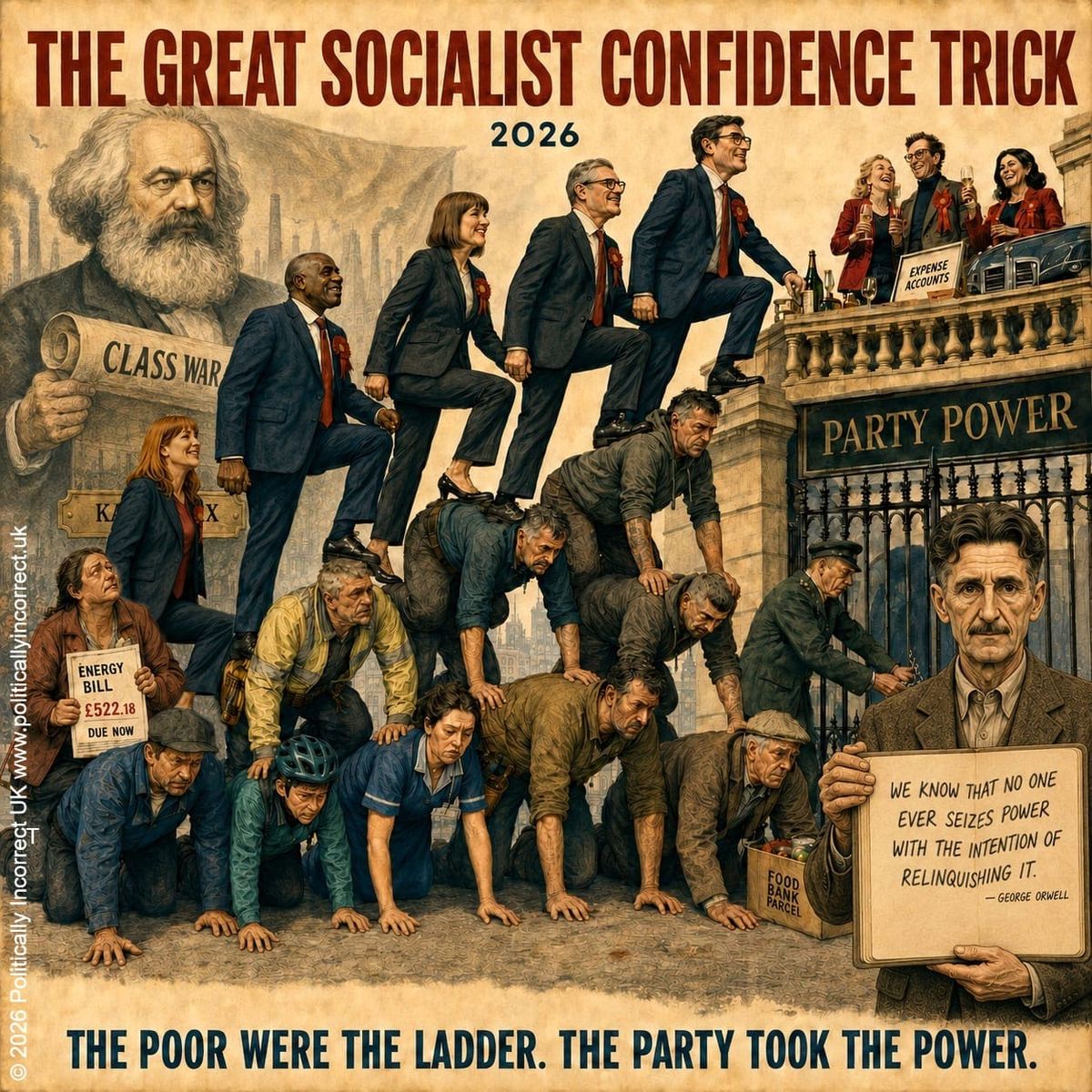
THE GREAT SOCIALIST CONFIDENCE TRICK
The party invoked class struggle and promised to lift working people. But once power was secured, were the poor raised up - or merely used as the ladder?
Karl Marx did not invent poverty. He discovered how poverty could be weaponised.
He took the genuine suffering of working people, transformed them into an abstraction called “the proletariat,” and presented class resentment as the engine of history. The poor ceased to be individual men and women - with families, faith, duties and aspirations - and became the human material of revolution.
Marx appointed himself their spokesman, despite never being a factory labourer and repeatedly depending upon Friedrich Engels - whose money came, rather inconveniently, from his family’s capitalist textile business. The great critic of capitalism was therefore sustained by its profits.
The promise was always power to the people. But the people were merely the ladder.
Generation after generation of well-dressed politicians has climbed upon the backs of struggling workers, promising equality, dignity and liberation. Once safely inside the gates of government, however, “the people” become taxpayers to be squeezed, voters to be managed and dissenters to be silenced.
Marx supplied the revolutionary blueprint. Modern politicians have refined the sales technique: speak continually about the poor, pose as their champions, exploit their hardships - and use them as a human staircase to power.
George Orwell - himself a man of the left - understood precisely where this confidence trick could lead. He saw how revolutions promising equality could merely replace one ruling class with another, while the slogans remained painted above the gate. In Nineteen Eighty-Four, he gave us the warning:
“We know that no one ever seizes power with the intention of relinquishing it.”
Then come the official cars, expense accounts, champagne receptions and locked gates.
The poor were promised power.
The Party took it.