MEN WITHOUT CHESTS - BUT WITH WARRANT CARDS
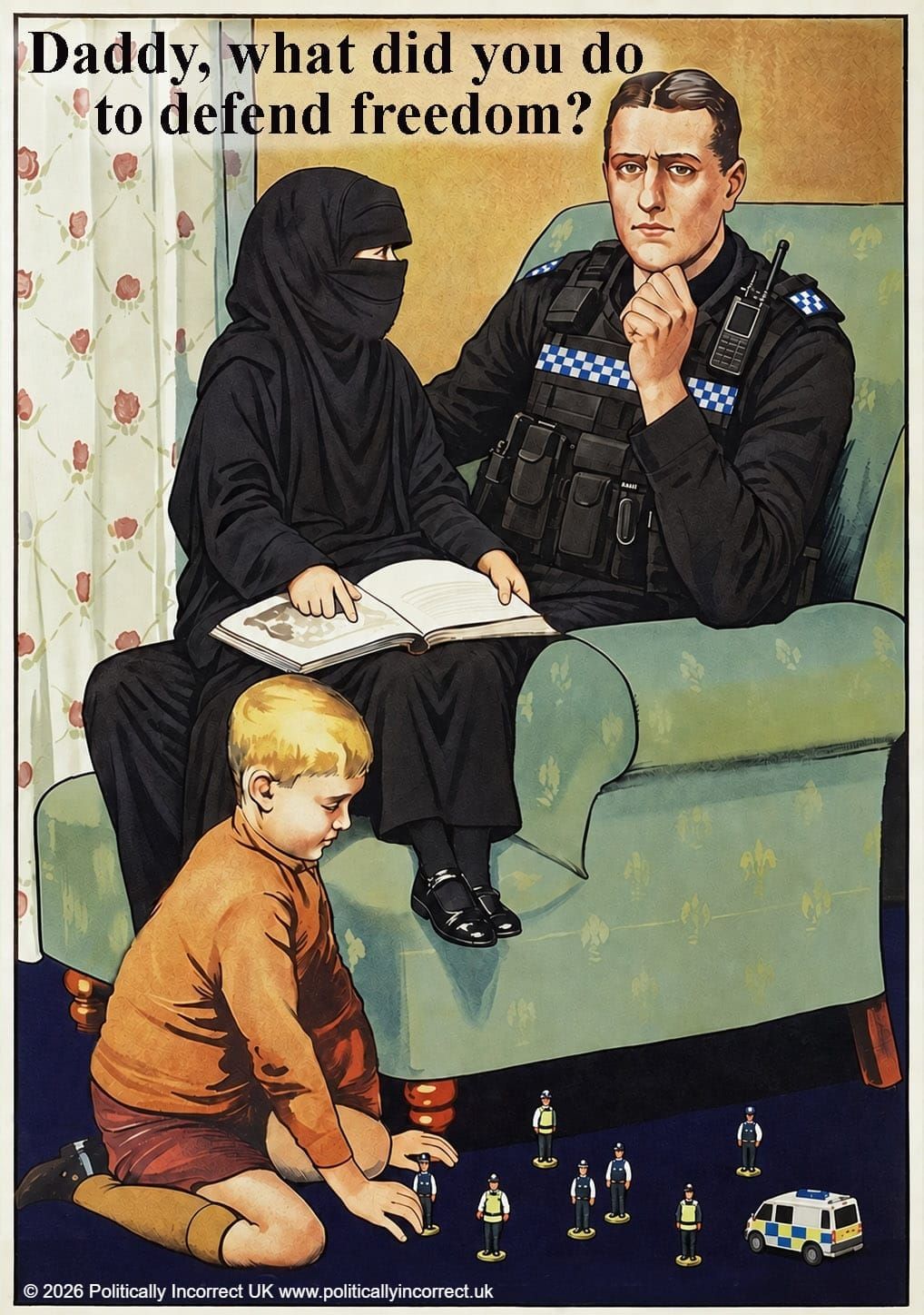
What will today’s police tell their children and grand children when asked whether they defended Britain’s freedoms - or quietly surrendered them?
C. S. Lewis warned:
“We make men without chests and expect of them virtue and enterprise.”
The head knows the law.
The belly fears complaints, disciplinary hearings and lost promotions.
The chest supplies the courage to do what is right when obedience becomes costly.
Look at the policeman’s face.
His daughter is not asking how many forms he completed, how many approved slogans he repeated, or how faithfully he protected his institution’s reputation.
She asks:
“Daddy, what did you do to defend freedom?”
Did you defend the innocent - or merely manage them?
Did you uphold one law for everyone - or enforce it according to who might complain most loudly?
Did you protect lawful speech when it became unpopular - or investigate the speaker because that was easier than confronting the threat?
Did you serve the public - or serve the political priorities handed down from above?
A uniform supplies authority.
It does not supply courage.
A warrant card grants legal power.
It does not provide moral judgement.
And “I followed policy” may satisfy a superior officer, but it will not satisfy conscience, history - or God.
Lewis understood the danger. Strip men and women of moral conviction, train them to distrust conscience, reward compliance above courage - and eventually the institution retains its power while forgetting its purpose.
Then society acts surprised when officers appear strong before the peaceful, cautious before the intimidating, and more concerned with “perceptions” than impartial justice.
Britain does not merely need more police officers.
It needs officers with the “chest” Lewis described: moral courage standing between reason and fear, joining knowledge of the law to the determination to uphold what is right.
Men and women whose impartiality cannot be purchased by political pressure.
Whose tolerance never becomes surrender to intimidation.
Whose loyalty is to truth and justice - not institutional reputation or fashionable ideology.
Who understand that wearing a uniform increases moral responsibility rather than removing it.
And who know that when conscience finally calls them to account, “I was only following policy” will be no defence at all.
The question in this picture is addressed to one policeman.
But it hangs over the entire institution:
WHAT DID YOU DO TO DEFEND FREEDOM?